
Why You Can’t Stay Consistent in Trading (It’s Not What You Think)
Apr 27, 2026
Reading time: 5 min
The Pattern Most Traders Recognize, but Can’t Explain
You start the day with a clear plan. You’ve prepared, you know what you’re looking for, and you’ve committed to following your rules. And yet, once the market opens, something shifts. Price starts moving, opportunities seem to appear and disappear within seconds, and the moment you hesitate or miss an entry, pressure begins to build.
What follows is often familiar. Instead of waiting for the next clean setup, you find yourself reacting, adjusting and chasing trying to make up for what just happened. By the end of the session, the experience feels disconnected from the plan you started with. When you review your trades, the gap between intention and execution becomes difficult to explain.
For many traders, this isn’t an occasional mistake. It’s a repeating pattern.
Why Consistency in Trading Feels So Difficult
What tends to surprise many traders is that this pattern has very little to do with discipline in the way they usually define it. Most traders I work with are not careless or uncommitted. In fact, they are often driven, ambitious and highly capable in other areas of life. They are used to solving problems, taking responsibility and following through.
And yet, in trading, something doesn’t translate.
They can follow their plan for a period of time, even build profits, but then one decision,often made under pressure, erases that progress. What follows is not just frustration over the loss itself but a deeper layer of doubt.
Questions begin to surface quietly: Maybe I’m not good enough. Maybe I need to work harder. Maybe I just lack discipline.
This is where most traders arrive at the same conclusion, they need more control.
But in trading, that assumption often leads them further away from consistency, not closer to it.
The Real Challenge: Operating Inside the Trading Environment
Every trader operates within a set of conditions that are very different from what most of us are used to in everyday life. I often describe this as three forces constantly interacting at the same time.
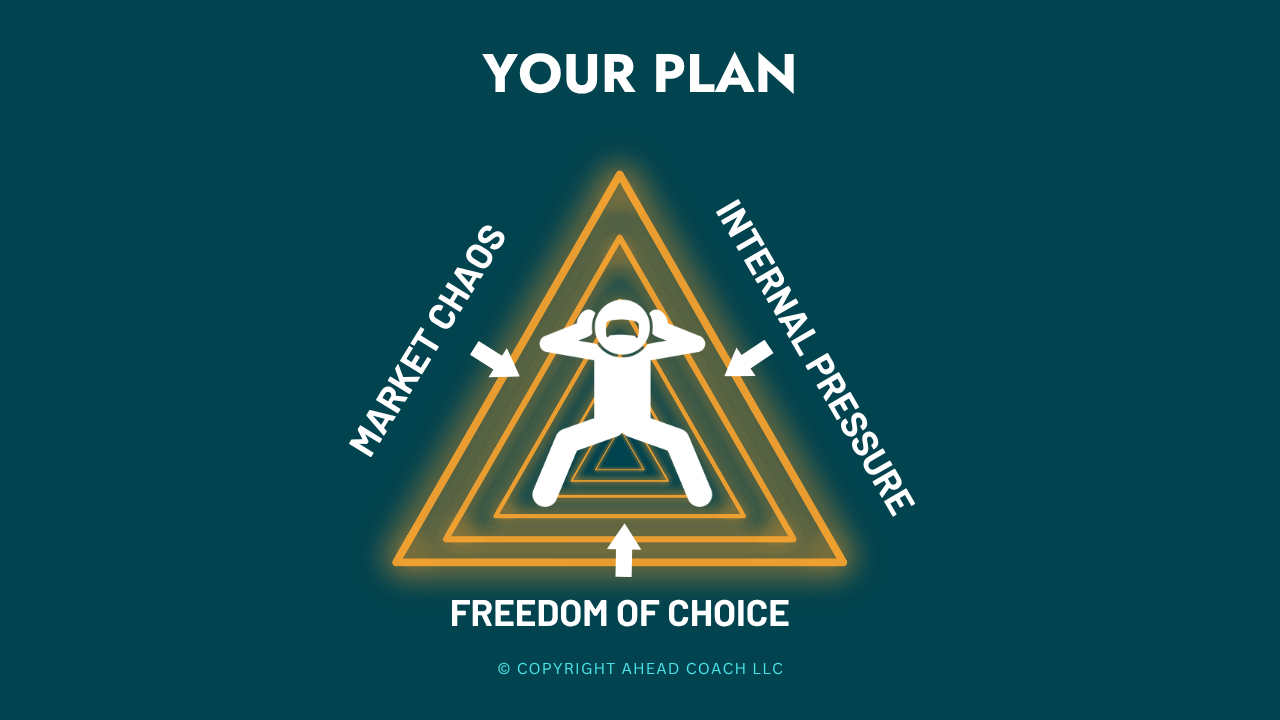
Market Uncertainty
The market is inherently unpredictable. There is no guarantee, no fixed outcome and no way to eliminate risk completely. As human beings, we are naturally conditioned to seek stability, reduce uncertainty and create a sense of control. Trading places you in an environment where those instincts are continuously challenged.
Internal Pressure and Emotional Activation
Every price movement has the potential to trigger a reaction. Losses, missed opportunities and even profits can activate emotional responses. Those responses are not just psychological but physiological. Your nervous system reacts to perceived risk, especially when money is involved, often influencing your decisions before you are even consciously aware of it.
Freedom of Choice and Responsibility
Unlike most structured environments, trading offers complete freedom. There is no manager, no external accountability and no predefined path. You are surrounded by choices: entries, exits, position size and strategy. Every decision carries full responsibility. While this freedom is often seen as an advantage, it also creates pressure in a different form.
Why Your Conditioning Works Against You in Trading
In most areas of life, certain behaviors are consistently rewarded. Acting quickly is seen as decisive. Working harder is associated with success. Taking control and solving problems is encouraged. Certainty is valued.
These patterns shape how we operate.
Trading, however, rewards something very different. It requires patience instead of urgency, restraint instead of constant action and the ability to tolerate uncertainty without immediately trying to resolve it.
This creates a conflict between how you have learned to succeed and what trading actually demands from you.
Why Pressure Isn’t the Real Problem
Many traders believe that pressure is the main obstacle to consistency. The assumption is that if they could just handle pressure better, they would finally be able to follow their plan.
But in practice, pressure often does the opposite of what traders expect. It sharpens focus, increases engagement and pushes action.
The more subtle challenge tends to appear in calmer conditions.
The Hidden Pattern: Overtrading in Calm Markets
When the market slows down and there is less to do, a different type of discomfort begins to surface. Without urgency, traders often feel restless and the absence of action can feel unproductive even when it is the correct decision.
This is where overtrading begins. Not because of pressure but because doing nothing feels uncomfortable.
Even after reaching a daily goal or generating meaningful profit, many traders continue to engage with the market, not because they need to, but because stepping away feels undeserved or incomplete.
Why Discipline Breaks Under Pressure
Discipline does not fail because you are weak or incapable. It breaks because the internal state you are operating from changes under different conditions.
When pressure rises, you don’t act from intention. You fall back on familiar patterns. Those patterns shaped by urgency, control and the need to resolve discomfort quickly. For many traders, that default state resembles survival rather than deliberate decision-making.
Why Tools Alone Don’t Solve Emotional Trading
Practices such as journaling, breathing and meditation are valuable. They play an important role in developing awareness and regulation over time. However, they are often misunderstood as immediate solutions.
Tools can support your ability to regulate your state, but they do not instantly override a strong emotional or physiological response in the moment. When approached as something you must “get right,” they can easily become another source of pressure which is another thing to manage, rather than something that supports you.
The Real Shift: What Creates Consistency in Trading
Consistency does not come from more effort, more discipline or more control. It comes from changing the conditions under which your behavior takes place.
When you begin to understand how your environment, your conditioning and your internal state interact is something shifts. You stop trying to force discipline and start building a system that supports it naturally.
That is what allows consistency in trading to become sustainable. It’s not because you are trying harder, but because you are no longer working against yourself.
The Shift That Changes Your Trading Results
At its core, the challenge of consistency is not about knowing what to do. Most traders already understand their strategy and their rules.
The real challenge lies in being able to operate from a state that allows those rules to be followed especially when conditions change and that is not something you solve by adding more control.
It is something you solve by changing how you relate to pressure, uncertainty, and your own responses within the trading environment.
If this feels familiar and you want to understand what actually happens to your decision-making under pressure, I break it down step by step here:
👉 Listen: What Most Traders Get Wrong About Performing Under Pressure on Apple Podcast or Spotify
WELCOME TO MY BLOG